b. Similarly, the first step for the Sectoral Approach is
to collect actual consumption statistics by fuel type and
economic sector (e.g., Public Electricity and Heat Production,
Petroleum Refining, Manufacture of Solid Fuels, and Other Energy
Industries).
c. The first step for a Tier 2 or 3 method is to collect
actual fuel consumption statistics by fuel type, economic
sector, and combustion technology type. Tier 3 methods use
activity data (e.g., kilometers traveled) as a proxy
to estimate fuel consumption or to estimate CO2
emissions directly using emission
factors.Tier 3 is generally used for estimating only non-CO2
emissions, because in most cases using actual fuel data is more accurate for estimating CO2 emissions.
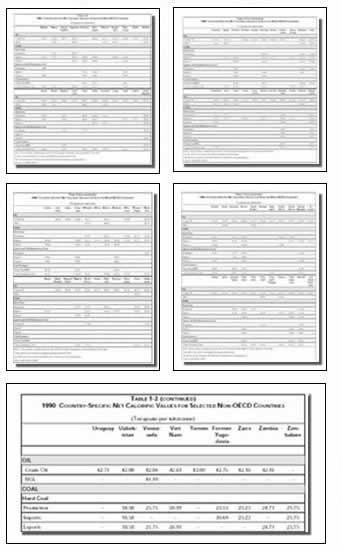
d. The second step is the conversion of fuel data to a common energy unit. In the
OECD/IEA Energy
Statistics and other national energy data compilations, production
and consumption of solid and liquid fuels are generally specified
in tonnes and gaseous fuels in cubic meters.
For consistency
purposes, original units (mass units) should be converted into energy units
using net calorific values (i.e., heating values). Where available,
different calorific
values for production, imports, and exports in a country
should be used.
For transparency
purposes calorific
values used for the conversion should be reported. Some countries
may report gross calorific values due to national statistics
systems.
|