| |
3.2 Non-CO2 Emissions
The methods (i.e., tiers) for estimating non-CO2 emissions
require different levels of activity and technology detail.
Tier 1. Emissions from all combustion
categories are estimated by multiplying the quantity of fuel consumed
by an average
emission factor. Tier 1 methods do not require detailed
activity
data.
Tier 2/3. Emissions are estimated by multiplying
the quantity of fuel consumed by detailed fuel type and technology-specific
emission factors.
Tier 1 methods rely on widely available fuel supply data
that assume an average combustion technology is used.
The difference between Tiers 2 and 3 is mainly an increase
in the degree of detail in the method. In general, Tier 2
methods use fuel consumption data that are disaggregated according
to technology types that are sufficiently homogenous to permit
the use of representative emission factors. Tier 3 methods
generally estimate emissions according to activity types (km
traveled or t-km carried) and specific fuel efficiency or
fuel rates or an emission factor or factors expressed directly
in terms of a unit of activity.
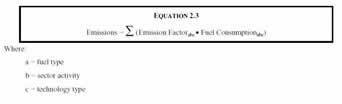
The general approach to estimate emissions from fuel combustion for each greenhouse gas and sub-source category is
Equation
2.3.
|