Stationary Combustion.
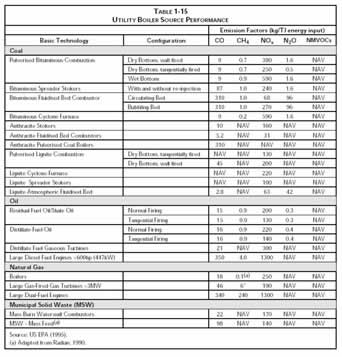
Default emission factors for CH4,
N2O, NOx, CO, and
NMVOCs by major technology and fuel types
are presented in the Revised 1996 IPCC Guidelines,
Reference Manual - Volume 3. Alternative
control technologies, with representative
percentage reductions are also shown.
These data show the range and variation
of sources and emission rates, as well
as the impact of the control technologies.
IPCC default emission factors for non-CO2 gases
Tables
1-15 to 1-19
Mobile Combustion. Emissions
of greenhouse gases (CH4 and
N2O) from mobile sources
can be estimated by major transport activity
(road, aviation, railways, and navigation). However,
as road transportation account for the
majority of mobile- source fuel consumption,
followed by air transport, greater priority
has been attached to the development of
emission models and inventories for road
vehicles and aircraft. The diversity of
mobile sources and the range of characteristics
which affect emission factors are demonstrated
and can be seen in the tables included
in the Revised 1996 IPCC Guidelines.
Emission factors for US vehicles
Tables
1-27 to 1-33
Emission factors for for European vehicles
Tables
1-36 to 1-49
Examples of aircraft types and emission factors
Tables 1-50 to 1-52
Table
2.7. Updated Emission Factors for USA Gasoline Vehicles
Table
2.10. Fuel Use and Average Sector Distance for Representative
Types of Aircraft
Fuel consumption factors for military aircraft
Tables
2.12 to 2.13
Of particular importance for many Parties are N2O
emissions from road transportation, which are significantly
affected by the type of emission control technologies in
use. Some catalyst-type control technologies increase the rate of N2O emissions relative to an
uncontrolled vehicle.
|