| |
Incomplete oxidation occurs due to inefficiencies in the combustion.
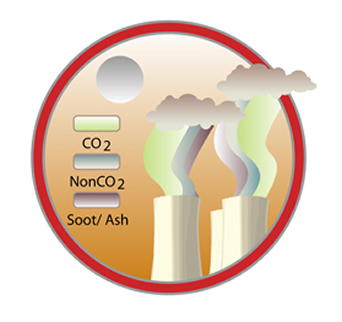
The carbon flow for a typical combustion process can be described
as follows:
- Most carbon is emitted as CO2 immediately.
- A small fraction of the carbon in the fuel escapes without being immediately oxidized to CO2 during combustion. Most of this fraction is emitted
as non-CO2 gases such as methane (CH4),
carbon monoxide (CO), and non-methane volatile organic compounds
(NMVOCs). The carbon in these gases, though, is assumed
to ultimately oxidize to CO2 in the atmosphere
and is therefore integrated into the overall calculation
of CO2 emissions (i.e., the carbon content value).
Therefore the carbon in these non-CO2 molecules
is intentionally “double-counted” because it
is eventually transformed into a CO2 molecule.[2]
- The remaining part of the fuel carbon is unburned (i.e.,
unoxidized) and remains as soot and ash. In general, this
fraction of the fuel carbon is assumed to remain stored
indefinitely (i.e., not emitted in gaseous form).
|