| |
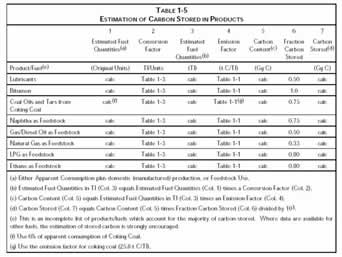
f. The fourth step is subtraction of the amount of carbon stored in products
for long periods of time (e.g., non-energy uses). The Reference
Approach requires information on the consumption of fuels
used for non-energy purposes where carbon may be stored (i.e.,
not oxidized and emitted to the atmosphere). The Reference
Approach uses a simple assumption: once carbon is brought
into a national economy in the form of a fuel, it is either
saved in some way (e.g. in increases of fuel stocks, stored
in products, or left unoxidized in ash) or it is emitted to
the atmosphere.
Some of the fuels supplied to an economy can be used for
non- energy purposes or as raw materials (i.e., feedstocks)
for the manufacture of products. A wide variety of products
are produced from oil refineries, including asphalt
and bitumen
for road construction, naphthas,
lubricants,
and others for production of plastics and fertilizers. Natural gas is used for ammonia
production. Liquid
petroleum gas (LPG) is used to produce solvents and synthetic
rubber. By-products of the coking process, oils and tars,
are used in the chemical industry. In some of these cases
the carbon in these fuels is oxidized to CO2 within
the non-energy process (e.g., carbon from natural gas used
in ammonia production). In other cases the carbon is indefinitely
stored (i.e., sequestered), although the carbon in some products
may be oxidized as the product ages or is disposed of. The
amounts stored for long periods are called stored
carbon and should be deducted from the carbon emissions
calculation.
Several approaches for estimating
the portion of carbon stored in products are
reviewed in the 1996 Revised IPCC Guidelines. It recommends that, whenever
possible, Parties should use country-specific data and assumptions
instead of relying on IPCC default fractions of carbon stored. |